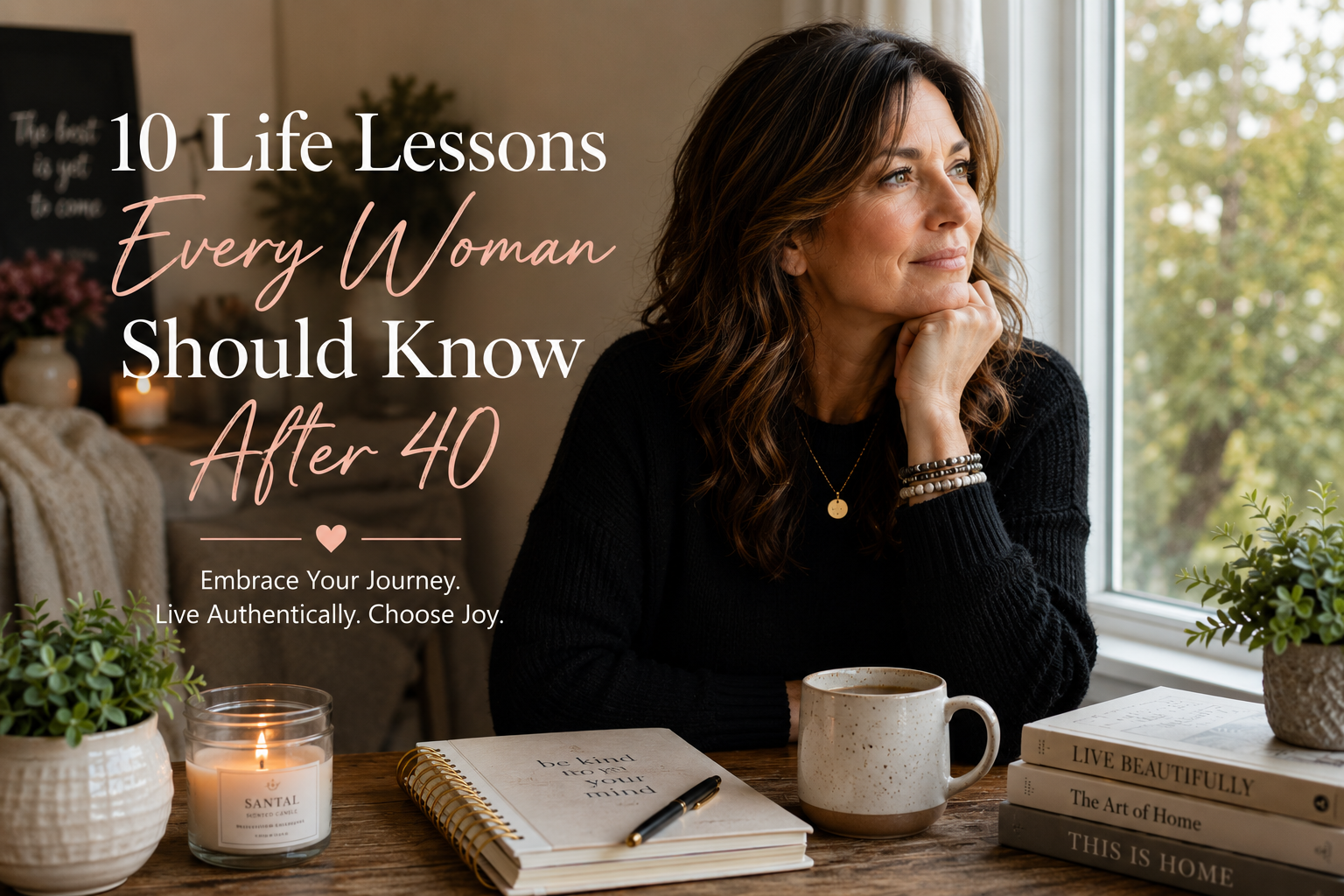
Turning 40 isn’t the beginning of the end—it’s the beginning of becoming unapologetically yourself.
Somewhere between the expectations of our twenties and the confidence of midlife, many women realize something profound:
The happiest life isn’t the one that looks perfect from the outside.
It’s the one that feels right on the inside.Whether you’re married, single, a mother, child-free by choice, or your life simply took a different path, these lessons are about creating a life that feels authentic, joyful, and entirely your own.
Maybe your life looks exactly as you imagined.
Maybe it looks nothing like the picture you had in your twenties.
Perhaps you’re raising children. Perhaps you’re an empty nester. Perhaps you’re happily child-free, still hoping to become a parent, or you’ve found purpose in entirely different ways.
Whatever your story, one truth remains:
A meaningful life isn’t measured by checking boxes. It’s measured by how fully you live it.
Every woman’s journey is unique, but certain truths seem to emerge with time. Some are learned through joyful milestones, others through unexpected detours. These first lessons are about building a strong foundation—one rooted in self-worth rather than society’s expectations.
Part One: Building a Life You Love
Lesson 1: Your Worth Isn’t Defined by Any Single Role
One of the greatest gifts that comes with turning 40 is the ability to separate your identity from society’s expectations.
Throughout our lives, we’re often encouraged to define ourselves by the roles we play—daughter, partner, wife, mother, caregiver, professional, or friend. While these roles can be deeply meaningful, none of them alone determine your worth.
You are so much more than a title.
Your value is reflected in the kindness you show, the relationships you nurture, the work you create, the wisdom you share, and the way you make others feel.
For many women, midlife brings the freedom to let go of the pressure to meet everyone else’s expectations. Some are raising children, some are enjoying life after their children have grown, and others have built fulfilling lives without becoming mothers. Every path has its own joys and challenges, and none is more meaningful than another.
The moment you stop measuring your life against someone else’s timeline, you create space to appreciate the beautiful life you’ve already built.
Ways to Celebrate This Lesson
Take inventory of the lives you’ve positively influenced—friends, family members, coworkers, students, neighbors, or members of your community. Legacy isn’t defined by a single role; it’s created through the countless ways we make a difference in the lives of others.
A guided gratitude journal or personal growth workbook can be a meaningful companion as you redefine success on your own terms.
Once you recognize that your worth isn’t defined by any single role, you begin making decisions from a place of confidence instead of comparison. That shift influences every area of life—including how you spend your time, your energy, and your money.
Lesson 2: Financial Independence Creates Freedom
Every woman has different opportunities and responsibilities when it comes to money, time, and planning for the future.
If you don’t have children, you may have greater flexibility to travel, pursue a career change, invest more aggressively for retirement, or simply spend your resources differently. If you’re raising children—or supporting adult children or grandchildren—your financial priorities may look very different.
Neither path is more meaningful than the other.
The important thing is to make intentional decisions based on your life, not someone else’s expectations.
Financial independence isn’t about having the biggest bank account. It’s about creating choices that give you peace of mind and the freedom to live according to your values.
Maybe you want to retire early.
Maybe you dream of spending six months traveling through Europe.
Maybe your goal is owning a cozy cabin, supporting charities you care about, or creating a financial safety net that lets you sleep peacefully at night.
Financial independence isn’t about becoming wealthy for the sake of appearances.
It’s about creating options.
In my 20s, budgeting felt restrictive. By my 40s, I realized budgeting was actually a form of self-care. Every dollar I intentionally saved became another layer of security, confidence, and freedom.
If personal finance has always felt intimidating, start small.
Read one book.
Open one investment account.
Automate one monthly savings transfer.
Small decisions repeated consistently often create extraordinary results.
Reflection
Imagine your ideal life ten years from now. What financial choices today would make that vision possible?
One thing that completely changed my relationship with money was using a simple budgeting planner. Seeing everything on paper made saving feel achievable instead of overwhelming.
Financial freedom isn’t just about saving for the future. It’s also about creating a life you genuinely enjoy today. One of the best places to invest in your well-being is the space you come home to every day.
Lesson 3: Your Home Should Tell Your Story
Home isn’t measured in square footage—it’s measured in how you feel the moment you walk through the front door.
It’s about how you feel when you walk through the front door.
For years, I decorated based on trends. I bought things because magazines said they were stylish or because everyone else seemed to have them.
Eventually, I realized my home didn’t feel like me.
So I started over.
I filled bookshelves with novels I’d actually read.
I bought ridiculously soft blankets, candles that reminded me of autumn, and framed photographs that made me smile every time I passed them.
Little by little, my home became less about impressing guests and more about nurturing myself.
That’s the beauty of your 40s.

You stop decorating for appearances and start designing for peace.
Whether you live in a downtown apartment, a country farmhouse, or a tiny cottage, your home deserves to reflect your personality, not someone else’s Pinterest board.
Try This
My favorite corner of the house isn’t the biggest room.
It’s one oversized chair beside a window.
A chunky knit throw.
A candle that smells like cedar and vanilla.
A small table stacked with books I’ve been meaning to read.
Every evening, that’s where I decompress.
Of course, a beautiful home isn’t defined by its furniture or décor. It’s the laughter shared around the kitchen table, the conversations on the back porch, and the people who make it feel alive that truly turn a house into a home.
💛 My Cozy Home Favorites
These are a few of the things that help me create a home that feels peaceful, cozy, and welcoming. If you’re creating your own favorite reading corner or relaxing space, these are wonderful places to start.
- A comfortable accent chair – Choose one that supports your back and gives you enough room to settle in with a book.
- A soft throw blanket – An easy way to add warmth, texture, and comfort.
- A warm table lamp – Soft lighting can make a space feel calmer and more inviting.
- Favorite scented candle – Adds a relaxing finishing touch.
Affiliate Disclosure: This article contains affiliate links. If you purchase through these links, I may earn a small commission at no extra cost to you. I only recommend products and services I genuinely believe can help you create a healthier, happier, and more intentional life.
Lesson 4: Friendships Become Family
One of the most beautiful surprises of adulthood is discovering that family isn’t always defined by DNA.
Some of the people who have stood beside me through life’s biggest moments aren’t relatives at all.
They’re friends who became sisters.
They’re neighbors who showed up with soup when I was sick.
They’re colleagues who celebrated promotions as if they were their own.
These relationships didn’t happen by accident.
They were built through shared experiences, vulnerability, laughter, and consistency.
As we grow older, friendships require intention.
Busy schedules, career changes, aging parents, and life transitions can quietly pull us apart if we’re not careful.
Don’t wait for someone else to organize the dinner.
Send the text.
Plan the weekend getaway.
Invite friends over for coffee instead of waiting for the perfect occasion.
The older I get, the more I believe that meaningful friendships are among life’s greatest investments.
They enrich every season.
Reflection
Who are the people who consistently make your life brighter? Reach out to one of them today—not because you need something, but simply because they matter.

Strong relationships enrich our lives, but healthy relationships also require healthy boundaries. Learning when to show up for others—and when to protect your own well-being—is one of the most valuable skills we develop in midlife.
Lesson 5: Protect Your Peace Without Feeling Guilty
Your 20s teach you how to say yes.
Your 40s teach you the power of saying no.
No to relationships that drain your energy.
No to obligations that leave you exhausted.
No to trying to make everyone happy.
For many women, boundaries don’t come naturally because we’ve been praised for being accommodating, dependable, and endlessly available.
But here’s what I’ve learned:
Every time you say yes to something that doesn’t align with your values, you’re quietly saying no to yourself.
Protecting your peace isn’t selfish.
It’s responsible.
It allows you to show up as your healthiest, kindest, and most authentic self.
One of the simplest habits I’ve adopted is asking myself a single question before agreeing to anything:
“If no one would be disappointed, would I still say yes?”
The answer is surprisingly revealing.
Give yourself permission to protect your time, your energy, and your emotional well-being.
They’re among your most valuable resources.
“You teach people how to treat you by what you allow.”
That lesson alone can change every relationship in your life.
Once you’ve learned to protect your peace, something wonderful begins to happen: you create space for growth. Midlife isn’t about slowing down—it’s about becoming more curious, more intentional, and more willing to embrace new opportunities. The next five lessons explore what it means to continue evolving long after society says you should have everything figured out.
The best chapters, after all, are often the ones we never saw coming.
Lessons 6–10
“The first half of life is about becoming who the world expects you to be. The second half is about becoming who you truly are.”
If there’s one thing I’ve learned in my 40s, it’s that growth doesn’t stop when we leave school, land our dream job, or reach a milestone birthday. In many ways, our 40s are when we become the most curious, courageous, and authentic versions of ourselves.
The next five lessons are about embracing that freedom—and giving yourself permission to keep evolving.
Lesson 6: Never Stop Learning—Curiosity Keeps You Young
One of the biggest myths about adulthood is that once we’ve established our careers and routines, we’re supposed to have everything figured out.
Nothing could be further from the truth.
Some of the most inspiring women I know didn’t discover their true passions until their 40s or 50s. One friend learned to paint after retiring from a corporate career. Another became fluent in Italian because she dreamed of spending summers exploring Tuscany. A former coworker launched a successful online business after years of believing entrepreneurship was only for younger people.
Their stories have one thing in common: they never stopped being curious.
Curiosity keeps life exciting. It reminds us that there are still books to read, skills to master, places to visit, and conversations waiting to change our perspective.
Research has consistently shown that lifelong learning can support cognitive health and emotional well-being, but beyond the science, it simply makes life more interesting.
Instead of asking yourself, “Am I too old to learn this?” try asking, “What could this experience add to my life?”
That subtle shift in thinking opens doors.
Try This Week
Choose one thing you’ve always wanted to learn but kept postponing. It could be photography, gardening, watercolor painting, coding, baking artisan bread, or learning a new language.
Spend just fifteen minutes exploring it.
You don’t have to become an expert.
You simply have to begin.
Curiosity often leads us beyond the pages of a book or the walls of a classroom. Sometimes the greatest lessons aren’t learned through study at all—they’re discovered while exploring new places and seeing the world through fresh eyes.
Lesson 7: Travel Because It Changes You, Not Just Your Passport
Travel has a remarkable way of reminding us who we are.
It’s easy to get caught in routines—commuting, grocery shopping, answering emails, paying bills. Then one trip, even a weekend getaway, interrupts the familiar and invites us to see the world through fresh eyes.
One of my favorite memories wasn’t an extravagant vacation. It was a quiet morning sitting at a neighborhood café while traveling, watching locals begin their day as I realized how refreshing it felt to slow down and simply be present.
No rushing.
No expectations.
Just curiosity and gratitude.
The beauty of travel is that it looks different for everyone. You might be exploring a new country on your own, taking a girls’ getaway with lifelong friends, planning a romantic escape with your partner, or making memories with your family. Every journey has something to teach us.
For many women, solo travel builds confidence in ways few other experiences can. It teaches you to trust your instincts, embrace the unexpected, and enjoy your own company. But meaningful travel isn’t defined by who you’re with—it’s defined by how open you are to the experience.
If traveling feels overwhelming, start small. Visit a nearby town you’ve never explored. Book a weekend bed-and-breakfast. Wander through a museum, botanical garden, or local farmers market.
Adventure doesn’t have to involve crossing oceans.
Sometimes it begins by simply saying yes to somewhere new.
Reflection
Where have you always wanted to go?
Write it down.
Then ask yourself:
“What’s one small step I could take this year to make that trip a reality?”
Dreams become plans when we give them a date.
Whether your adventures take you across the world or simply across town, they’re easier to enjoy when your health supports the life you want to live. Investing in your well-being is one of the greatest gifts you can give your future self.
Lesson 8: Invest in Your Health Before You Need To
If I could give my younger self one piece of advice, it would be this:
Your future health is built by today’s habits.
Our culture often talks about health only after something goes wrong, but true wellness isn’t about reacting—it’s about preparing.
Your 40s are the perfect time to prioritize movement, nourishing food, quality sleep, preventive screenings, and stress management.
Not because you’re getting older.
Because you deserve to feel your best.
I’ve stopped thinking of exercise as punishment for what I ate.
Now I think of it as gratitude for what my body still allows me to do.
Walking with friends.
Carrying groceries.
Dancing in my kitchen while dinner cooks.
These ordinary moments become extraordinary when we appreciate them.
Health isn’t about perfection.
It’s about consistency.
Drink another glass of water.
Take the walk.
Schedule the annual check-up you’ve been postponing.
Stretch before bed.
Little choices accumulate over time.
A Gentle Reminder
Your body has carried you through every joyful season and every difficult one.
Treat it with the kindness it deserves.
Caring for your health often gives you something even more valuable than energy—it gives you confidence. And confidence has a remarkable way of inspiring change. Whether it’s pursuing a new dream, changing careers, or starting over, it’s never too late to reinvent yourself.
Lesson 9: Reinvention Isn’t Reserved for Your Twenties
Somewhere along the way, many of us absorbed the idea that major life changes have an expiration date.
By 40, we’re supposed to have chosen the career.
Found the relationship.
Purchased the home.
Settled down.
But life rarely follows neat timelines.
Some women begin entirely new careers in midlife.
Others move across the country.
Some finally write the novel they’ve dreamed about for decades.
Others leave relationships that no longer reflect who they’ve become.
Reinvention doesn’t require permission.
It requires courage.
Everything you’ve lived through has prepared you for what comes next.
Your mistakes become wisdom.
Your setbacks become resilience.
Your experiences become your greatest qualifications.
Consider This
If fear weren’t part of the equation, what would you change?
Your answer may point directly toward your next chapter.
Reinvention deserves to be recognized. Yet so often we’re quick to celebrate everyone else’s milestones while quietly overlooking our own. Maybe it’s time we changed that.
Lesson 10: Celebrate Yourself More Often
Why do we wait for other people to celebrate us?
We celebrate weddings.
Baby showers.
Graduations.
Retirements.
These are wonderful milestones, but they’re not the only moments worth honoring.
Life is filled with quieter victories that deserve just as much recognition.
Celebrate paying off debt.
Celebrate earning your degree at 45.
Celebrate changing careers after years of feeling stuck.
Celebrate completing therapy.
Celebrate caring for a loved one through a difficult season.
Celebrate taking your dream vacation.
Celebrate saying yes to a new opportunity—or finally saying no to something that no longer serves you.
And yes, celebrate birthdays, too.
Every chapter you’ve lived has shaped the woman you’ve become.
One of my favorite traditions is buying myself fresh flowers after reaching a personal goal. They’re a simple reminder that I don’t need to wait for someone else to acknowledge my accomplishments.
You don’t need permission to celebrate your growth.
Life becomes richer when we pause to recognize how far we’ve come instead of constantly focusing on what’s next.
Create Your Own Tradition
Choose one way you’ll celebrate your next personal milestone.
Maybe it’s a favorite meal at a local restaurant.
A relaxing spa day.
Fresh flowers for your kitchen table.
A weekend getaway.
Or simply taking an afternoon off to do something that fills your cup.
The tradition matters less than the intention behind it.
Because every step forward—big or small—is worth celebrating.
When you look back over these first ten lessons, a pattern begins to emerge. None of them are about chasing perfection or meeting someone else’s expectations. They’re about creating a life that reflects your values, your priorities, and the woman you’re still becoming.
Wrapping Up Part One
If you’ve noticed a common thread running through these first ten lessons, it’s this:
A meaningful life isn’t built all at once.
It’s created through hundreds of small, intentional choices that reflect your values instead of someone else’s expectations.
Whether you’re learning a new skill, booking your first solo adventure, investing in your health, redefining your career, or simply buying yourself flowers because you accomplished something important, every choice sends yourself the same powerful message:
If these first ten lessons have taught us anything, it’s that fulfillment isn’t something we discover one day.
It’s something we create.
One conversation.
One boundary.
One adventure.
One quiet morning.
One courageous decision at a time.
And if you’re wondering whether your best years are behind you, I hope this reminds you that some of life’s richest chapters are written after 40. And the beautiful thing is, you’re the one holding the pen.
Before you move on to the next chapter, take a moment to pause. Growth doesn’t happen by rushing from one lesson to the next. It happens when we reflect on what resonates and choose one small step to carry forward.
Reflection Questions
- Which lesson challenged your thinking the most?
- What is one change you can make this month that your future self will thank you for?
- If you could rewrite one “rule” you’ve been living by, what would it be?
- Which dream have you been postponing simply because you thought it was too late?
I’d love to hear your answers in the comments below. Your experiences may encourage another woman who needs the reminder that she’s exactly where she needs to be.
If this article resonated with you, consider sharing it with a friend, sister, or colleague who might need encouragement. Sometimes the most meaningful gift we can give another woman is the reminder that her story is still unfolding.
What’s Coming in Part Two
In the next installment, we’ll explore Lessons 11–20, including:
- Letting go of perfectionism
- Building deeper relationships
- The power of saying yes to joy
- Why confidence grows with age
- Creating a legacy beyond motherhood
- Finding purpose through service
- Embracing aging with gratitude
- Making peace with your past
- Living intentionally every day
- Defining success on your own terms
Together, these lessons will continue building a roadmap for creating a fulfilling, intentional life after 40—one that’s rooted in authenticity, connection, and the freedom to define happiness for yourself.
A Little Thank You: Some links in this post may be affiliate links. If you choose to shop through them, I may earn a small commission at no additional cost to you. As an affiliate, I earn from qualifying purchases. Your support helps keep The daZie Diaries going, and I’m so grateful you’re here. 🤍